


A dispute at the company behind Dolly Parton’s business empire shows how quickly family and business relationships can collide after an owner dies, and what Ohio business owners can put in place now.
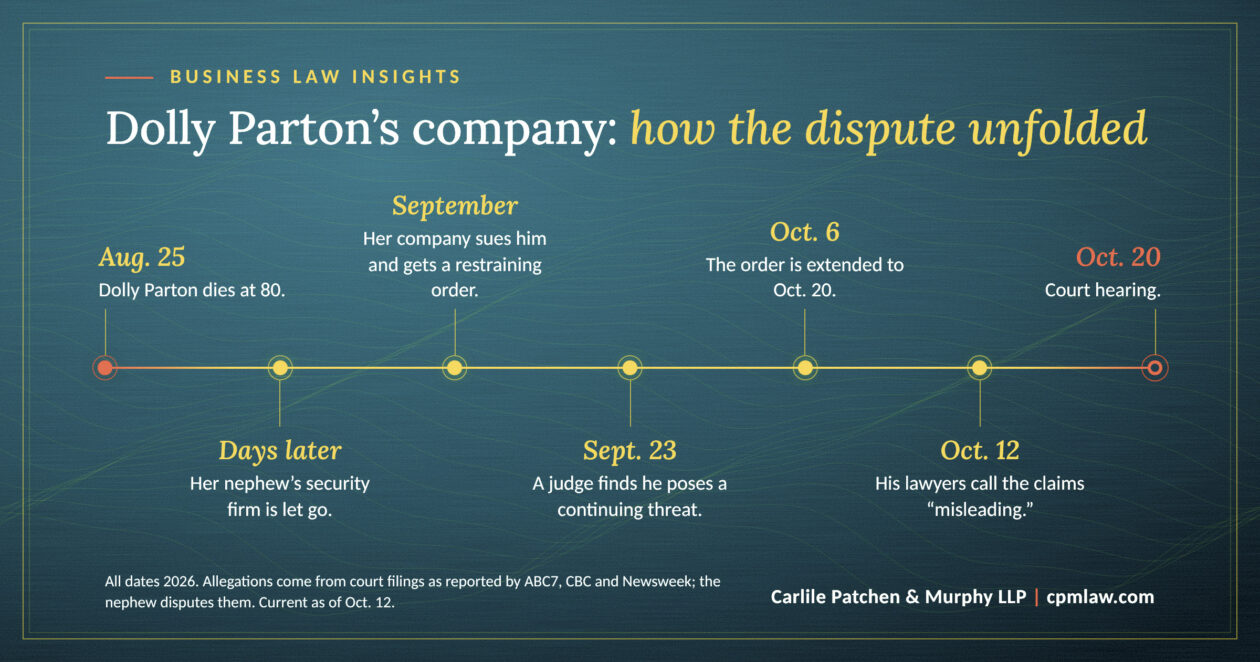
Dolly Parton built far more than a music career. She built a business: tours, licensing, recordings, real estate and a brand recognized around the world. When she died on August 25 at age 80, that business didn’t stop. It had employees to pay, contracts to honor and a brand to protect.
Within weeks, it also had a legal fight.
She’s Alive LLC, the company set up to oversee Parton’s estate, has sued her nephew Bryan Seaver, according to news reports. Seaver worked for years as Parton’s head of security through his own company, and he is also a beneficiary of Parton’s trust.
She’s Alive LLC is managed by Parton’s long-time business manager Danny Nozell. He alleges that Seaver used threats and intimidation to interfere with business relationships after Seaver’s security company was terminated. Seaver denies the allegations.
Seaver’s attorneys say his messages were taken out of context, that the restraining order was issued before he had a chance to be heard, and that the family wants a quick, amicable resolution. A Nashville court has extended the restraining order, and a hearing is set for October 20.
We don’t know all the details of Parton’s planning, and the court will sort out the facts. But the dispute highlights a situation many Ohio family businesses will recognize: one relative who is a vendor, an employee and an heir all at once, a manager responsible for protecting the business, and no founder to call when things break down.
What Dolly got right
Based on public reporting, parts of Parton’s estate plan appear to have provided continuity after her death by identifying decisionmakers and preserving mechanisms for business management.
- A company with a manager in charge. One of the entities overseeing Parton’s estate and business interests, She’s Alive LLC, is managed by Parton’s longtime business manager Danny Nozell, allowing someone with authority to act quickly after Parton’s death.
- A trust. Seaver is reported to be a beneficiary of Parton’s trust, which suggests her assets pass privately rather than through a public probate case.
- Business and inheritance kept apart. Based on public reports, Seaver’s status as a beneficiary appears distinct from his security-related business relationship, illustrating a common estate-planning goal of separating employment, contracting and inheritance rights.
Compare that with Prince, who died in 2016 without a will and whose estate took years to settle, or Aretha Franklin, whose handwritten wills turned up in her home (one in a couch) and led to years of court fights among her sons. Parton’s estate is in court over one relationship, not over what she wanted.
Even a strong plan can’t control how people react. What it can do is give the people in charge the tools to respond. Here’s how Ohio business owners can build the same foundation.
Keep family, business and inheritance roles separate
Many owners hire relatives on a handshake. When the owner is gone, the people left in charge need to know exactly what was agreed. Every family member who works for or sells to the business should have a written agreement covering:
- Scope of work and compensation
- How either side can end the relationship, and what notice or payment is owed
- Whether the agreement continues, changes or ends when the owner dies or the business is sold
- Return of company property, keys, devices and access credentials
Clear terms protect the family member, too. They remove guesswork at an emotional time.
Separation matters most when one person wears several hats. In the Parton dispute, news reports note that ending Seaver’s security role did not change his status as a trust beneficiary. That is what good planning aims for: a person’s job, contract and inheritance each stand on their own, so a business decision doesn’t become a family inheritance fight, or the other way around.
Make Sure someone has authority on day one
In Parton’s case, a company already existed with the authority to act, including going to court. Many closely held Ohio businesses aren’t so prepared. If the owner held all the decision-making power personally, the business can stall while an estate is opened. That gap is common. In a recent Deloitte Private survey of family business executives, 85% said succession planning is critical to long-term success, yet only 57% had a plan and fewer than a quarter were actively implementing one.
It also helped that the company has an experienced business manager in charge. For many families, a trusted non-family manager, co-trustee or advisory board can make hard business calls that would be painful for a relative to make.
An operating agreement or shareholder agreement should name successor managers or officers. Holding the ownership interest in a trust lets a successor trustee step in immediately, without waiting on probate.
Protect what insiders know
Security staff, assistants, bookkeepers and long-time family employees often know everything: schedules, finances, passwords and private family matters. Confidentiality agreements, limited access to sensitive systems and a plan to promptly change credentials when someone leaves are basic protections. They matter most when a departure is not amicable.
Own your name and brand inside the business
For many business owners, the name on the door is the company’s most valuable asset. Trademarks, domain names, social media accounts and, for some owners, the right to use their name and likeness should be owned or licensed by the business, with clear instructions for who controls them after death.
Ohio law protects a person’s right of publicity for decades after death, and that right can be planned for like any other asset. (For a look at how brand disputes play out in court, see What Ohio Businesses Need to Know From the Buc-ee’s Lawsuits.)
Plan for disagreement before it happens
The time to decide how disputes will be handled is while everyone still gets along. Mediation or arbitration clauses, provisions allowing a court to quickly stop threatened harm, and clear termination rights give the people running the business tools to act quickly and calmly.
The takeaway
Most family businesses run on trust and long relationships, and that’s a strength. But after a founder dies, the people left in charge need documents, not memories. A review of your operating agreement, family employment and vendor arrangements, and succession plan can keep your business steady when it matters most.
Is your business ready to run without you?
Carlile Patchen & Murphy’s business succession planning and estate planning attorneys help Central Ohio family businesses put the right documents in place — operating agreements, trusts, family employment and vendor agreements, and a clear chain of authority — before anyone needs them. Schedule a succession planning review with our team in Columbus or Dublin, or call 614.228.6135.
Want more practical guidance for business owners? Read more CPM insights and subscribe to Business Law Insights.



0 Comments